A crypto venture fund is a pool of investor money that buys stakes in early blockchain companies and token projects. The idea sounds simple. The details are not. Crypto funds mix classic venture mechanics with things traditional funds never deal with, like token vesting, custody of digital assets, and positions that can become liquid years before an IPO would ever happen. If you are trying to understand how these funds are built, what they charge, and where the money is actually going, this guide walks through the whole machine using current deal data.
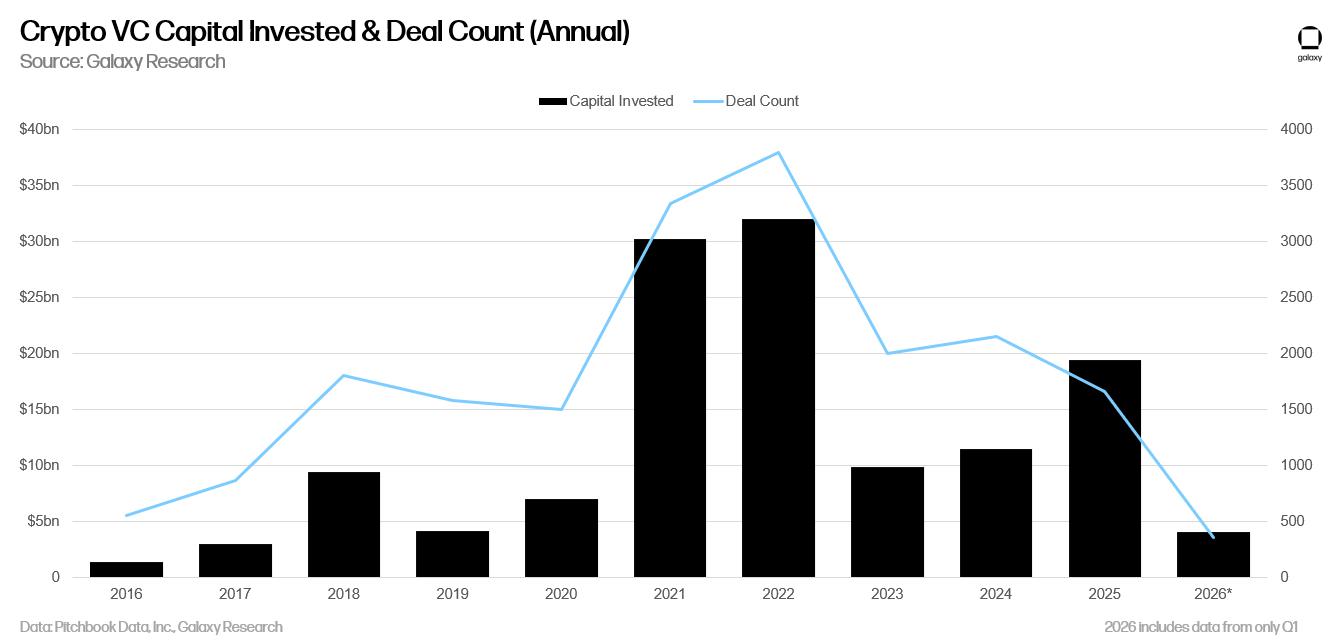
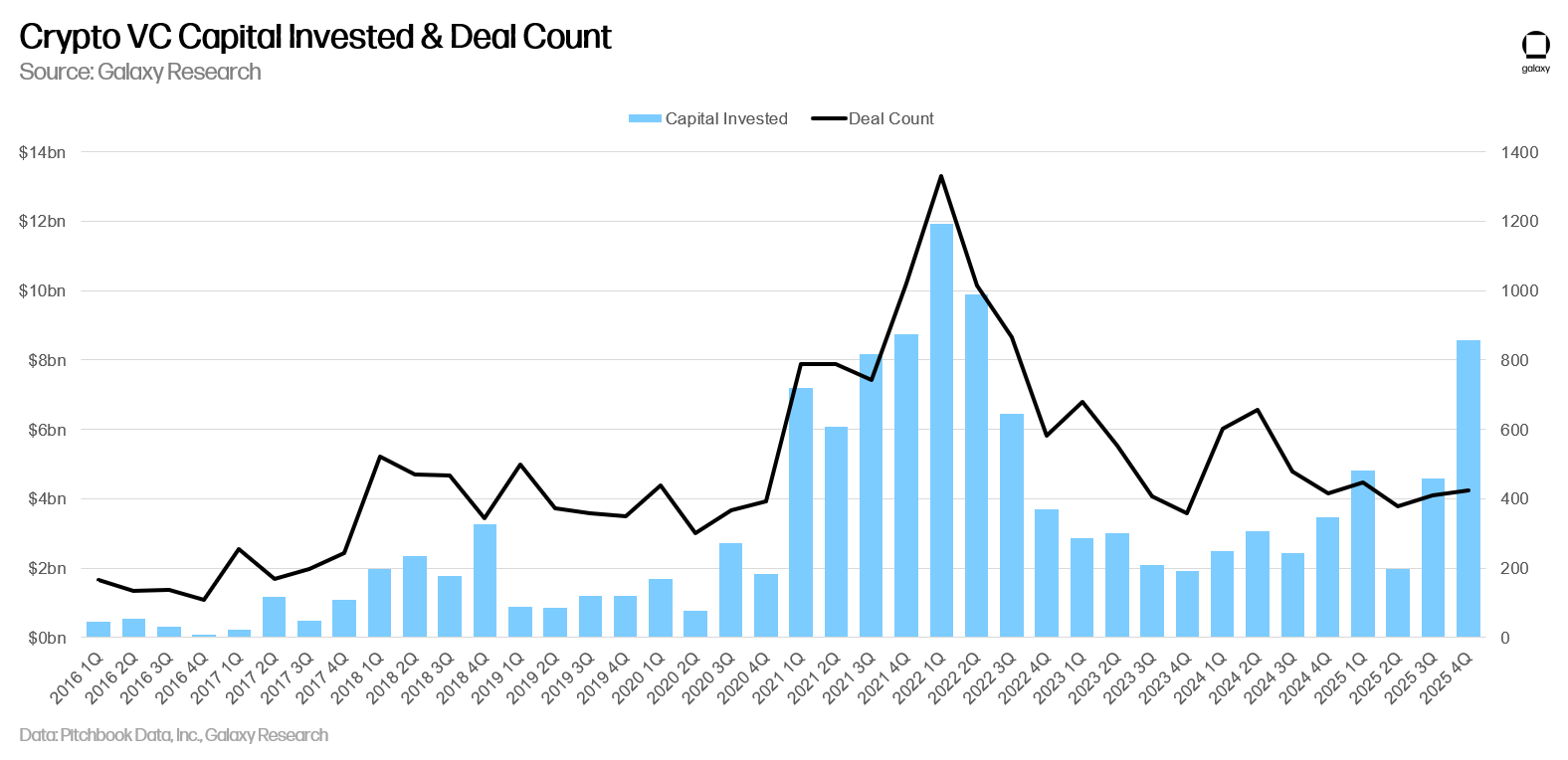
The numbers matter here because the market has changed shape. Galaxy Research counted about $8.5 billion invested across 425 deals in the fourth quarter of 2025, but 11 mega-deals took roughly 85 percent of that capital. Fund formation tells an even sharper story. In 2022, crypto funds raised close to $38 billion across roughly 260 new vehicles. In the first quarter of 2026, new crypto funds raised just $1.1 billion across 8 funds, the fewest since the third quarter of 2020. Fewer, larger, more selective funds are writing the checks now, and that changes how founders and investors should approach them.
Quick solution
If you just need the shape of it: a crypto venture fund is almost always a closed-end limited partnership that runs about ten years. Outside investors, called limited partners or LPs, commit money. The manager, called the general partner or GP, calls that money in pieces over three to five years and invests it in startups and token networks. The GP charges a management fee of about 2 percent of committed capital per year plus carried interest of about 20 percent of profits. Crypto-specific twists: funds often hold tokens as well as equity, they may take token warrants that convert later, and they need qualified custody for digital assets. To evaluate one, check the team's realized exits, their custody setup, their fund size against their stated stage focus, and how they handled the 2022 to 2023 drawdown. The data below shows where funds deploy today so you can tell a focused thesis from a story.
Strip away the crypto branding and the base structure is a standard venture limited partnership. Three parties make it work.
The limited partners supply the capital. These are endowments, family offices, funds of funds, and wealthy individuals. They sign a limited partnership agreement, commit a fixed amount, and have no say in individual investments. Their liability is capped at what they committed.
The general partner runs the fund. The GP sources deals, negotiates terms, sits on boards, and decides when to sell. The GP also invests its own money alongside LPs, usually 1 to 2 percent of the fund, so it has skin in the game.
The management company employs the investment team and collects the management fee. It is legally separate from each fund so one firm can run several funds at different stages of their lives.
A crypto venture fund layers new pieces onto this frame. The fund documents must allow the fund to hold tokens directly, not just shares. The fund needs a custody answer, since private keys are bearer instruments and an LP will ask who holds them. And the fund often negotiates token warrants, which are rights to receive a project's future token, alongside or instead of equity. None of this changes the partnership skeleton, but it changes the operational load a manager has to carry.
Fund sizes swing with the cycle. Galaxy's fundraising data shows the average new crypto fund raised over $300 million at the 2022 peak, with a median near $99 million. By mid-2025 the average had fallen to roughly $98 million and the median to about $56 million. The market moved from mega-vehicles back toward small, focused funds, then in early 2026 nearly stopped minting new funds at all.
The fund lifecycle from first close to final distribution
A crypto venture fund lives in phases, and knowing which phase a fund is in tells you a lot about its behavior.
Fundraising comes first. The GP pitches LPs, holds a first close once enough capital is committed, and may keep raising for another year until a final close. During the lean stretch since 2024, many managers held smaller first closes and extended their raise windows.
The investment period usually covers years one through four. The GP calls capital from LPs as deals close, rather than taking all the cash up front. Most funds target 25 to 40 core positions, reserving a third to half of the fund for follow-on rounds in winners. A seed-focused crypto fund will spread small checks widely; you can see how that plays out on the receiving side in our guide to crypto seed funding.
The harvest period covers roughly years five through ten. The GP supports portfolio companies, deploys reserves, and looks for exits. Crypto gives this phase a twist that traditional venture does not have: token unlocks. A fund that bought a token warrant in 2023 may start receiving liquid tokens in 2025 while the equity of the same startup stays private for years longer. Managers must decide whether to distribute tokens to LPs in kind, sell on a schedule, or hold. The fund agreement has to spell out who makes that call.
Distributions close the loop. When a portfolio company is acquired or a token position is sold, proceeds flow back to LPs first until they recover their capital, then profits split, typically 80 percent to LPs and 20 percent to the GP as carried interest. Acquisitions have become the realistic exit path for most crypto startups, which we cover in detail in crypto mergers and acquisitions.
More in Venture & Funding
Where crypto venture funds deploy capital now
Thesis claims are cheap. Deployment data is not. Galaxy's category breakdown shows how the mix of funded sectors has shifted quarter by quarter since 2022.
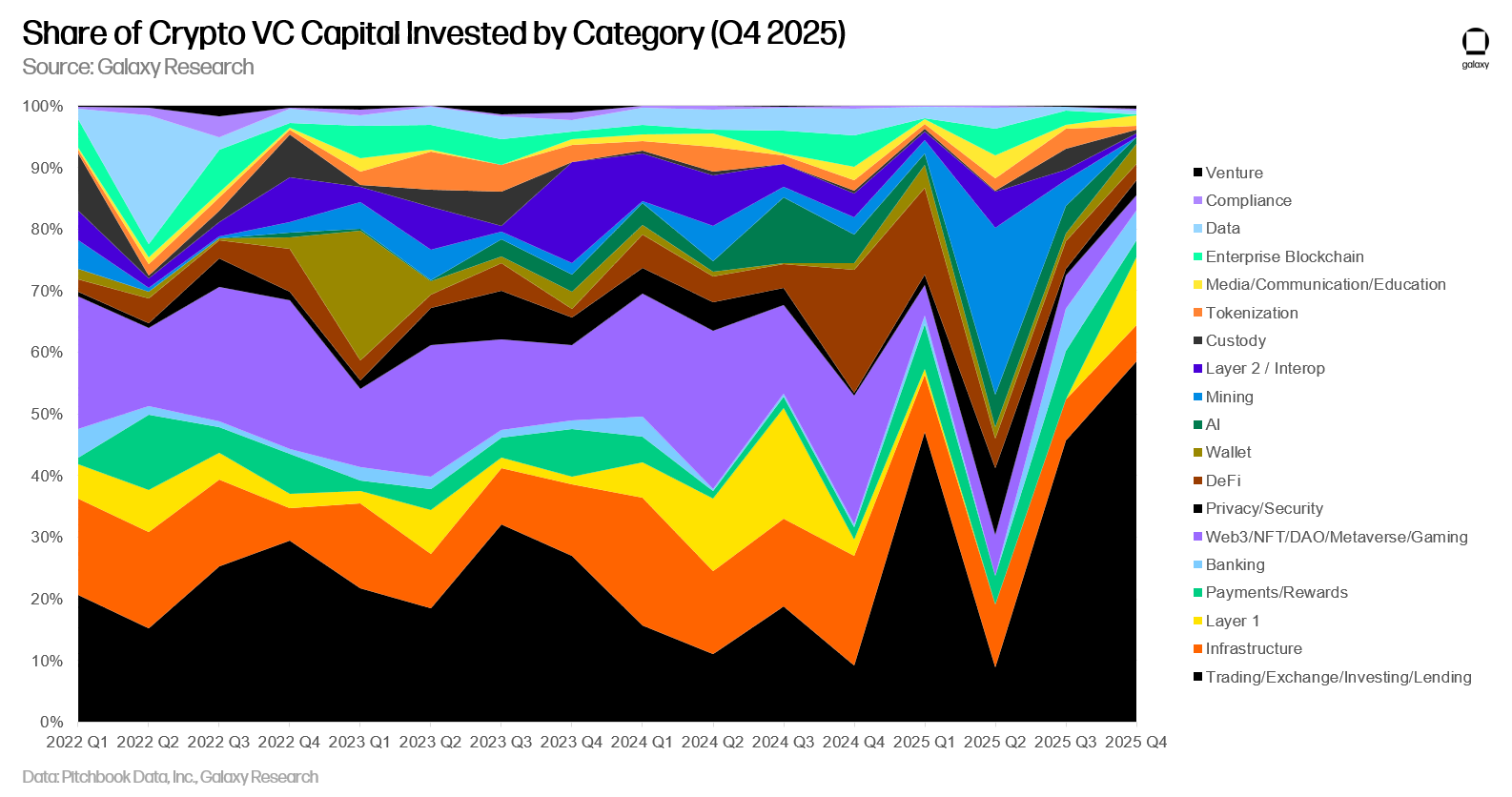
A few patterns stand out. Trading, exchange, investing, and lending companies have absorbed the largest single share of capital across most quarters, because they generate revenue in ways that map cleanly to valuation models investors already trust. Infrastructure and stablecoin-adjacent categories climbed as payments volume became a real business. AI-crypto crossover projects went from a rounding error to a steady slice of every quarter. And the categories that dominated 2021 headlines, like NFT platforms and metaverse gaming, shrank to thin bands.
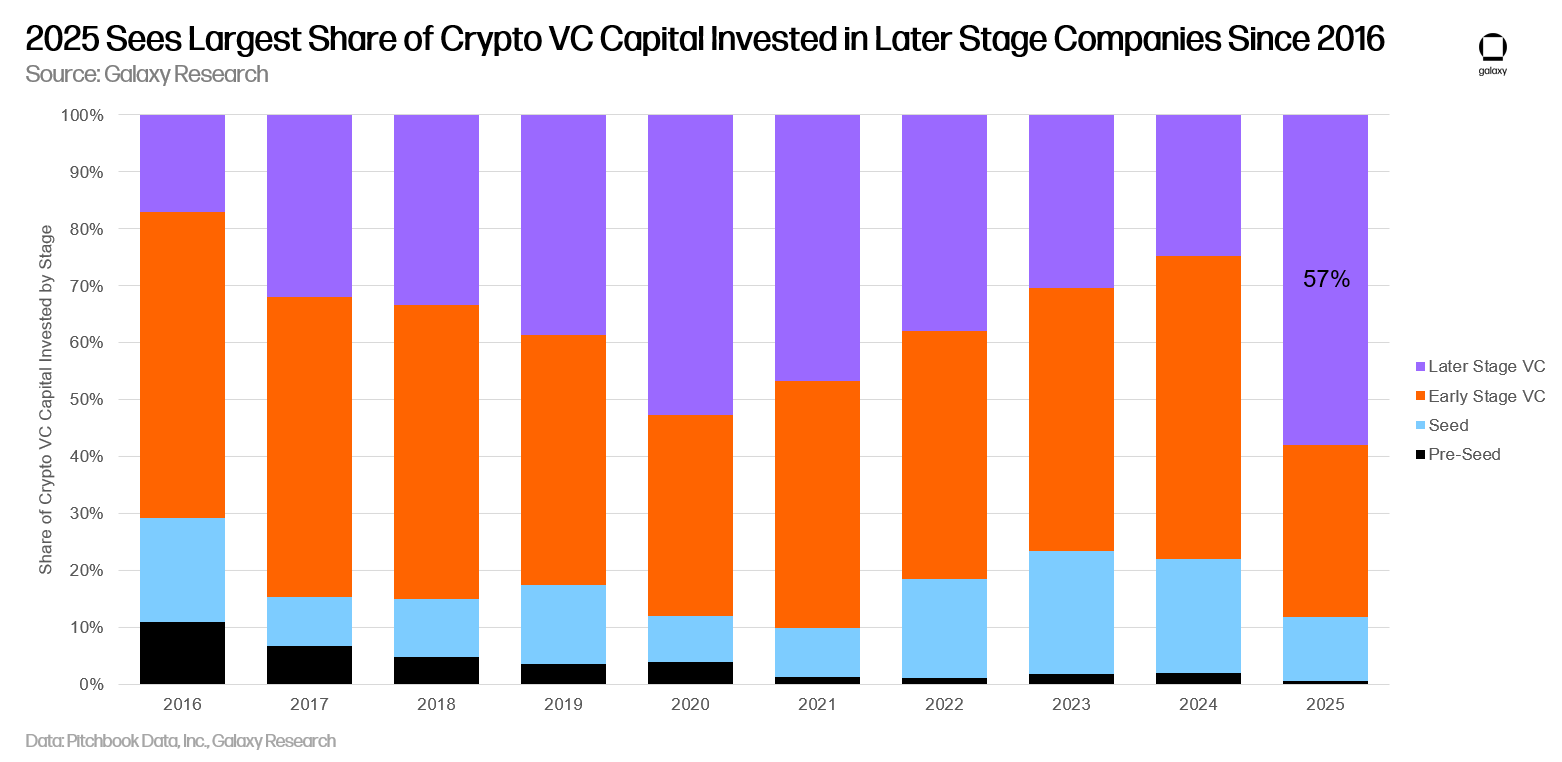
The stage dimension matters just as much as the sector dimension. Capital concentrates in later-stage rounds within a handful of categories, while early-stage checks spread across everything.
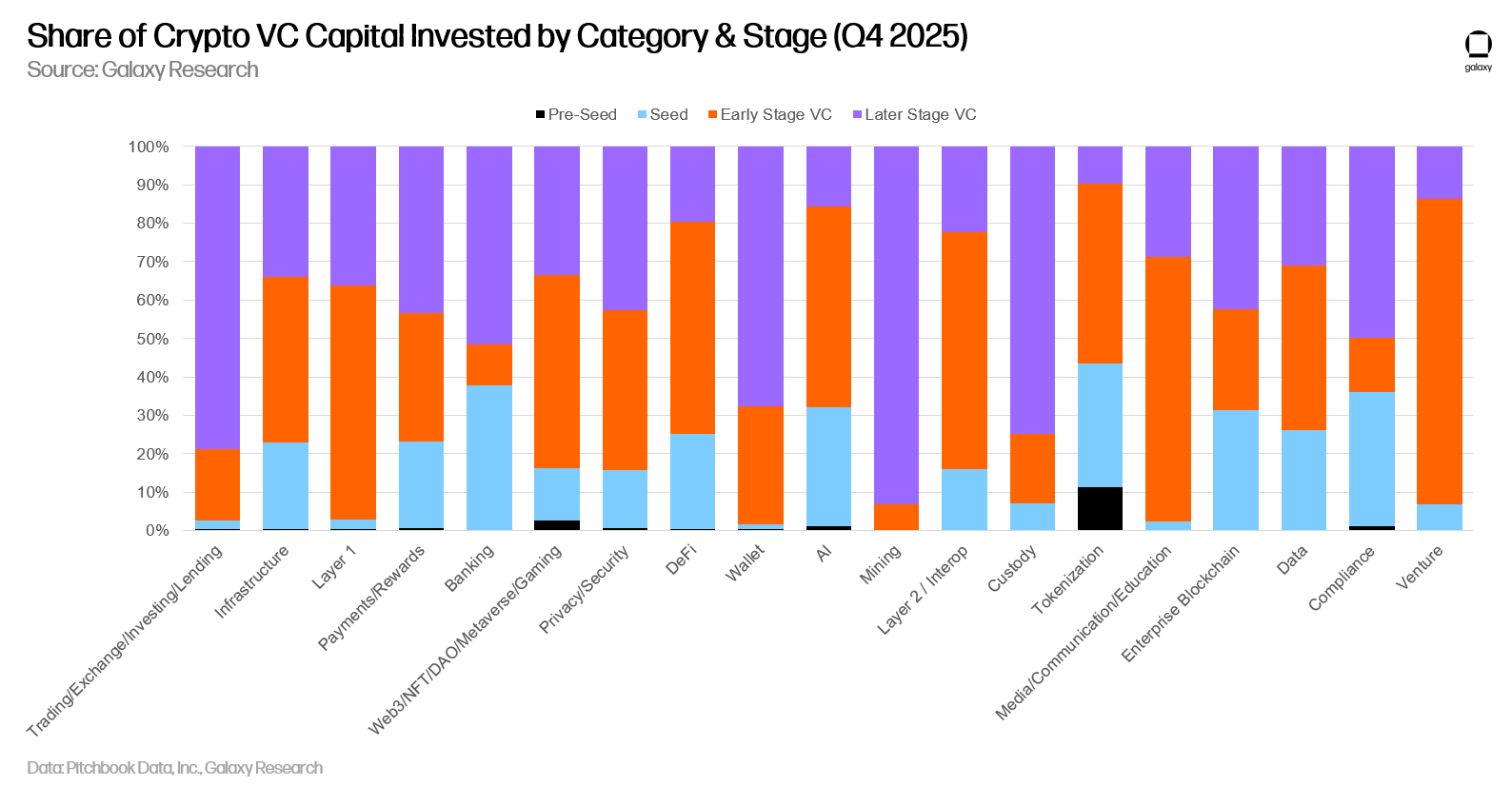
In the first quarter of 2026 this concentration got even more pronounced. Galaxy counted about $4 billion across 355 deals, and later-stage rounds took 57 percent of the capital, an unusually high share for a market that historically skewed early. Giant single rounds, like Revolut's $3 billion raise and Kraken's $800 million round, can move an entire quarter's stage mix on their own. If you want the round-by-round mechanics behind those numbers, see our breakdown of crypto funding rounds.
What stage data tells you about fund strategy
Capital share tells you where the dollars go. Deal count tells you where the activity is. The two charts disagree in a useful way.
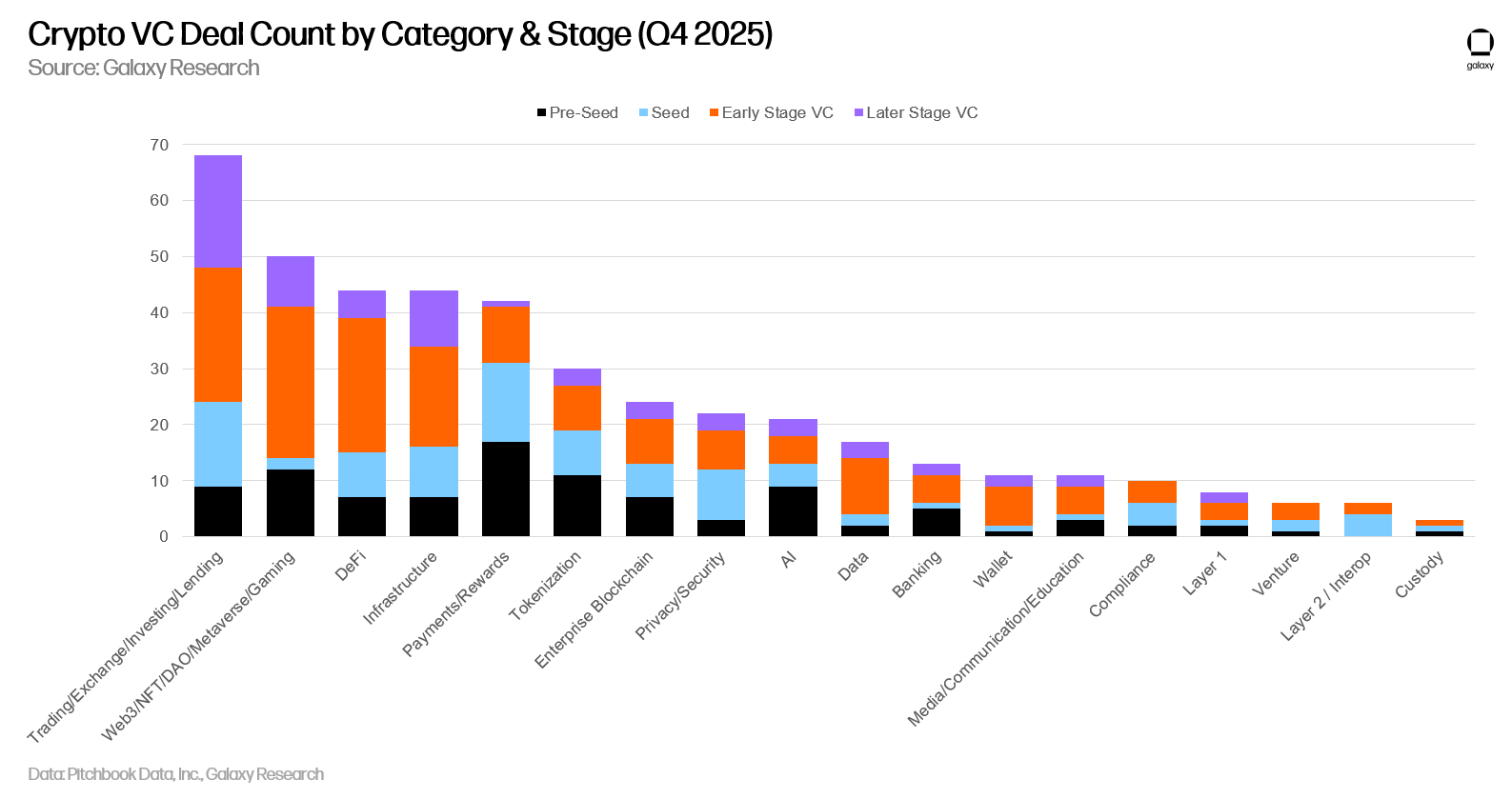
By deal count, pre-seed and seed rounds dominate almost every category even when they barely register in dollar terms. That is the structural reality of venture: hundreds of small checks feed a funnel that narrows to a few large ones. A fund's stated stage focus should match its fund size. A $50 million fund writing $500 thousand seed checks can build a 40-position portfolio with reserves. A $500 million fund cannot live on seed checks; it must chase later rounds or huge token positions to move its own needle.
The share view of deal activity makes the funnel explicit. Earlier in 2025, seed and pre-seed deals made up more than half of all deal count in most categories, while later-stage deals clustered in mining, trading, and privacy infrastructure.
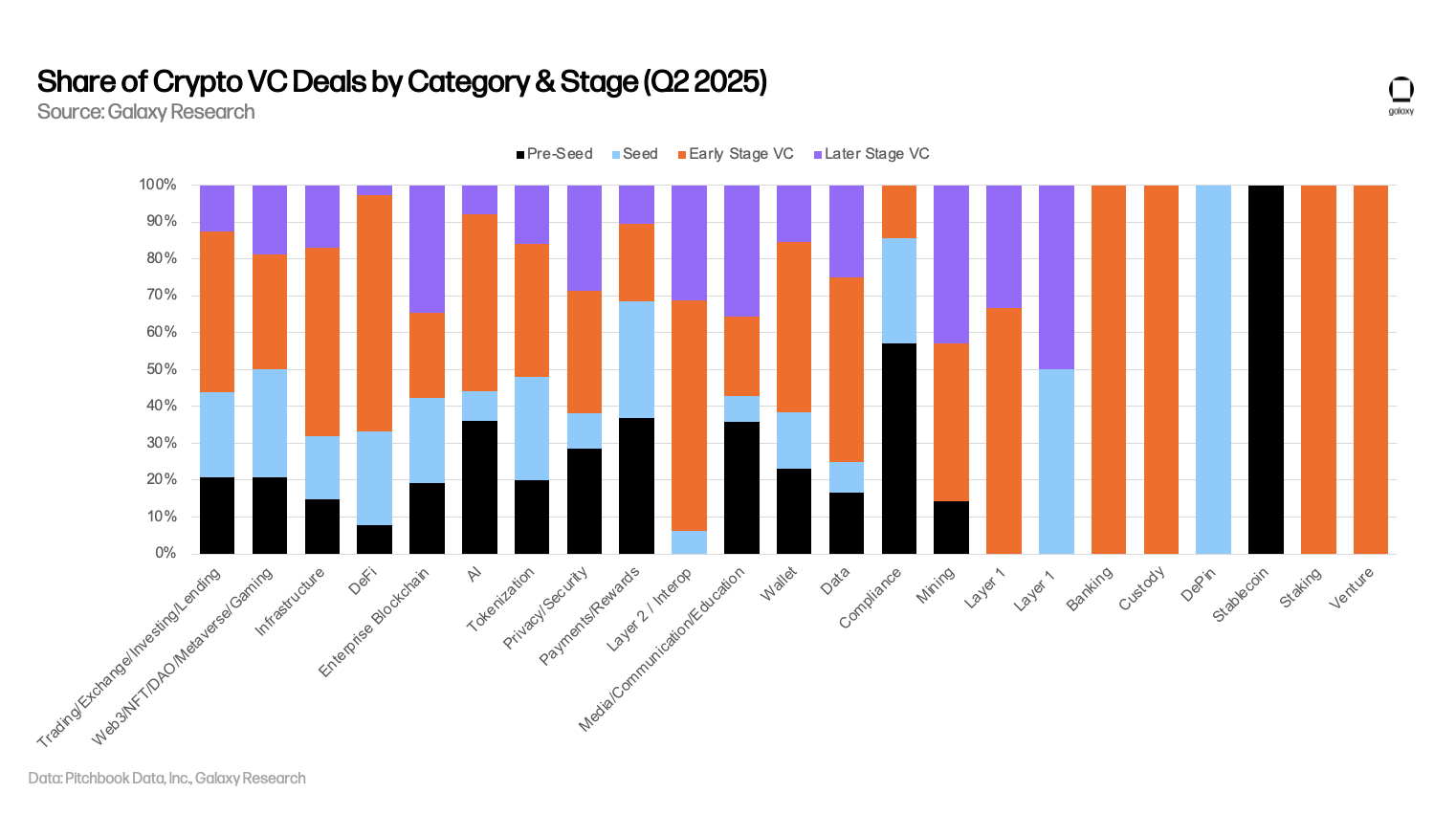
For a founder, this data answers a practical question: which funds are actually active at your stage and in your category this year, as opposed to the funds with the loudest brands. For an LP, it answers a different one: whether a manager's claimed strategy matches where the market is actually transacting. A fund pitching a late-stage DeFi thesis in a quarter where late-stage DeFi barely printed deals needs a very good explanation.
Fees, terms, and fund economics compared
Crypto investors can get venture exposure through several vehicle types, and the fee mechanics differ more than most people expect. We compiled the typical terms from Galaxy Research's fund formation data and standard market practice into one view. Ranges reflect common market terms, not any single fund's documents.
| Vehicle type | Typical fees | Liquidity | Lifespan | What you actually hold |
|---|---|---|---|---|
| Crypto venture fund | 2% management, 20% carry | Locked until exits | About 10 years | LP interest in equity and token positions |
| Liquid token fund | 2% management, 20% incentive | Quarterly or annual redemptions | Open-ended | Fund share priced on liquid tokens |
| Fund of funds | Around 1% plus 10%, on top of underlying fund fees | Locked, often 12+ years | Longest | Interests in many venture funds |
| Angel or direct investing | No fund fees, legal costs per deal | Locked per position | Per company | Direct equity or SAFE or token warrant |
The venture fund's lockup is the price of access to rounds you cannot reach otherwise. The liquid token fund gives up that access in exchange for redemption rights. The fund of funds buys diversification with a second fee layer that compounds against returns. Direct investing avoids fees entirely but concentrates risk in a handful of positions and demands your own diligence on each deal, which is the subject of our guide to crypto due diligence.
Carried interest deserves one more note. Carry is usually paid only after LPs get their full capital back, and better-aligned funds add a preferred return, often 8 percent, that LPs earn before any carry accrues. In crypto, ask specifically how carry is calculated on token positions that become liquid early. A fund that marks tokens at a peak, distributes them in kind, and takes carry on the marked value has shifted price risk onto its LPs.
Whether you are an LP considering a commitment or a founder choosing an investor, the evaluation comes down to evidence over narrative.
Start with realized performance, not marks. Unrealized gains on token positions can evaporate. Ask for distributions to paid-in capital, the DPI ratio, which counts only cash and liquid assets actually returned. A 2021-vintage crypto fund with meaningful DPI navigated the worst drawdown in the asset class's history; that is signal.
Then check operational depth. Who custodies keys, and is the custodian qualified? How are token unlocks handled? Is there a compliance function that predates the current regulatory thaw? Funds that survived 2022 tend to have real answers because the ones that did not are gone.
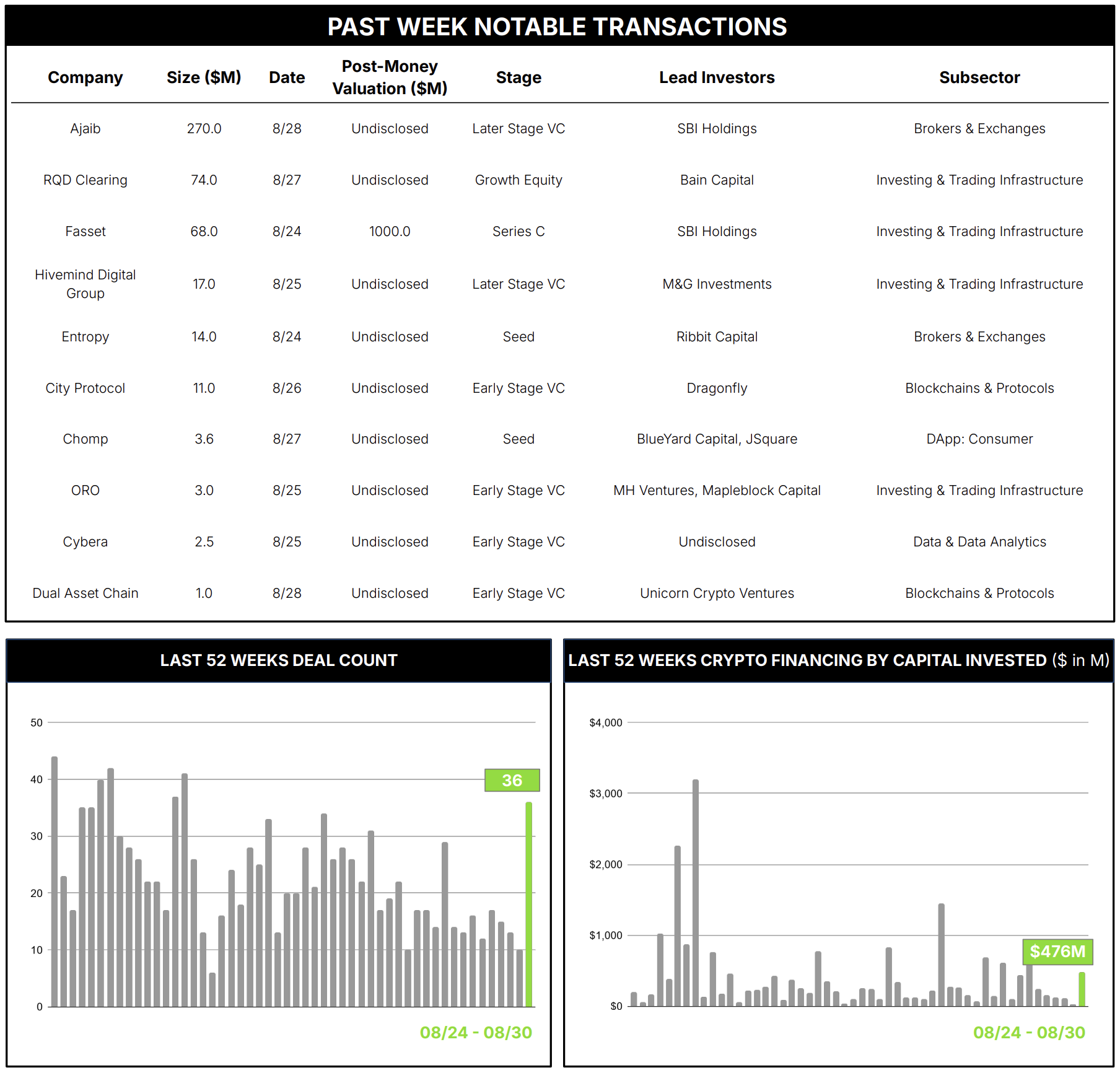
Deal flow is the third leg. A fund only outperforms if it sees the good deals early. Weekly transaction trackers give you an independent read on who is actually in the flow. Architect Partners' snapshot for the last week of August 2026, for example, lists Ajaib's $270 million round led by SBI Holdings, RQD Clearing's $74 million growth round from Bain Capital, and Fasset's $68 million Series C, against a rolling 52-week tracker of 36 deals and roughly $476 million.
Real reader situations show how the same evaluation flexes:
"We are a family office allocating to crypto for the first time, and every manager deck we see claims top-quartile returns." Ask every fund for DPI by vintage year, then compare against Galaxy's fundraising data for those vintages. A 2022-vintage fund should be judged against the brutal 2022 cohort, not against 2021 marks. Anyone refusing to separate realized from unrealized returns has answered your question.
"We are a seed-stage founder choosing between a large multi-stage fund and a small crypto-native fund." Check which one has actually led seed rounds in your category in the last four quarters, using the deal count data above. A mega-fund's seed check often comes with less attention; a crypto-native fund's whole business is your stage. Then model dilution across your next two rounds with our guide to crypto startup valuation.
"We are a fintech corporate development team asked to co-invest alongside a venture fund in a custody startup." Treat the fund's diligence as a starting point, not a substitute for your own. Ask for their investment memo, verify the token warrant terms yourself, and confirm what happens to your co-investment rights if the fund sells its position early.
Common mistakes when investing through crypto venture funds
The same errors repeat across cycles, and most of them are visible in advance.
- Judging a fund by its logo wall. A famous portfolio built at 2021 prices can still be a bad fund. Entry price and realized exits determine returns, not name recognition.
- Ignoring the token side of the documents. If the limited partnership agreement is silent on token distributions, in-kind transfers, and carry on unrealized token marks, you will discover the answers at the worst possible moment.
- Confusing committed capital with deployed capital. A fund that raised $200 million in 2022 and deployed 80 percent of it at peak valuations has little dry powder left for the current market, whatever its size suggests.
- Treating fund count collapse as a reason to stay away. The 2026 fundraising drought means less competition for deals and lower entry valuations for the funds still writing checks. Historically, tight vintages have produced strong returns because capital scarcity disciplines pricing.
- Skipping the reference calls. Two calls with founders the fund actually backed, and one with a founder it passed on, tell you more than any data room about how the firm behaves when things go wrong.
Frequently asked questions
How much money do I need to invest in a crypto venture fund?
Most funds require LPs to be accredited investors or qualified purchasers, with minimum commitments that commonly run from $250 thousand to several million dollars. Some newer feeder platforms pool smaller commitments, but they add a fee layer. The capital is called over several years rather than paid all at once.
What is the difference between a crypto venture fund and a crypto hedge fund?
A venture fund makes illiquid, long-term investments in private companies and early token projects, locks capital for about a decade, and returns money as positions exit. A hedge fund trades mostly liquid tokens, offers periodic redemptions, and marks to market continuously. Some firms run both under one brand, which is exactly why you should read which entity you are actually committing to.
How do crypto venture funds make money on tokens instead of equity?
Funds negotiate token warrants or simple agreements for future tokens alongside equity. When the network launches, the fund receives tokens on a vesting schedule. It can then sell into liquidity, distribute tokens to LPs in kind, or hold. This can return capital years faster than an acquisition, but it also creates pricing and custody questions that pure equity funds never face.
Why did crypto fund fundraising fall so hard after 2022?
Three forces stacked: LPs were burned by 2022 marks and paused new commitments, higher interest rates made illiquid strategies less attractive across all of venture, and the 2021 fund cohort had deployed at peak prices, so performance data lagged. The result was a slide from roughly $38 billion raised in 2022 to $1.1 billion across 8 new funds in the first quarter of 2026.
Is a smaller crypto venture fund better than a larger one?
Neither is automatically better; the question is fit between fund size and strategy. Small funds can double their value on one seed winner but lack reserves for later rounds. Large funds can support companies for years but need billion-dollar outcomes to matter. The mismatch to avoid is a large fund claiming a seed strategy or a tiny fund claiming it can lead growth rounds.
Sources
Galaxy Research, "Crypto & Blockchain Venture Capital Q4 2025," published February 3, 2026.
Galaxy Research, "Crypto & Blockchain Venture Capital Q1 2026," published May 28, 2026.
Architect Partners, "Crypto Private Financing Snapshot," week of August 24–30, 2026, published September 2026.