Crypto venture capital is how most of the industry's exchanges, wallets, infrastructure companies, and protocols got built. Before a token ever trades and before a product ever ships, someone usually writes a check. Understanding how that process works — who invests, at what stage, in what amounts, and in exchange for what — helps founders plan a raise, helps job seekers judge an employer's runway, and helps everyday users figure out whether the app holding their assets is well funded or running on fumes.
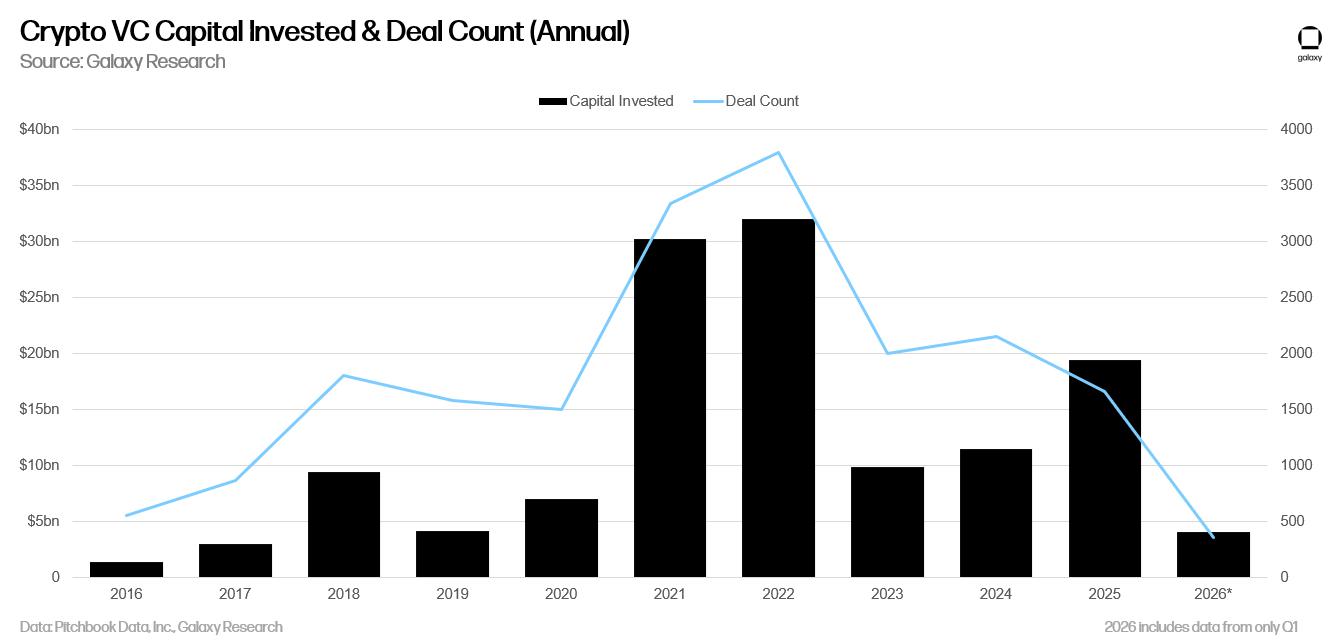
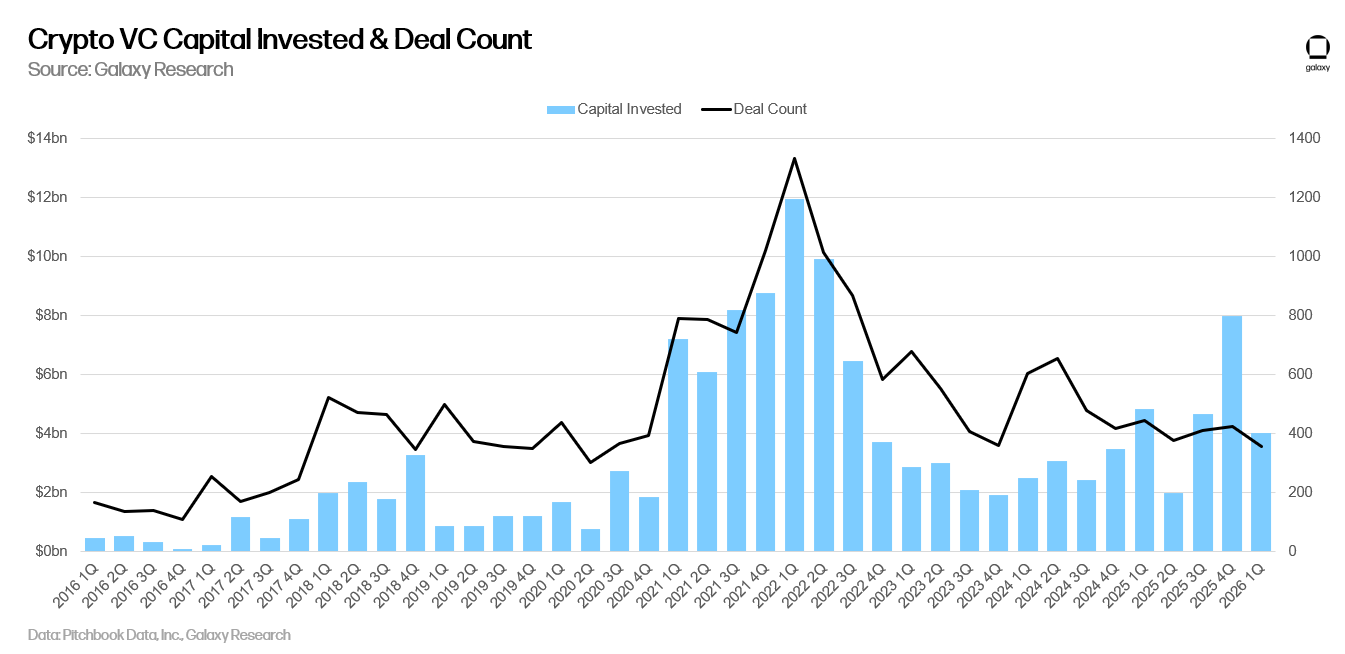
The market is large and measurable. Galaxy Research, which tracks the sector using Pitchbook data and its own VisionTrack database, counted roughly $20 billion invested in crypto and blockchain startups across 1,660 deals in 2025 — the biggest year since 2022 and more than double 2023's total. In the first quarter of 2026, venture capitalists deployed about $4 billion more across 355 deals. This guide walks through what those numbers mean and how the machine actually works.
Quick solution
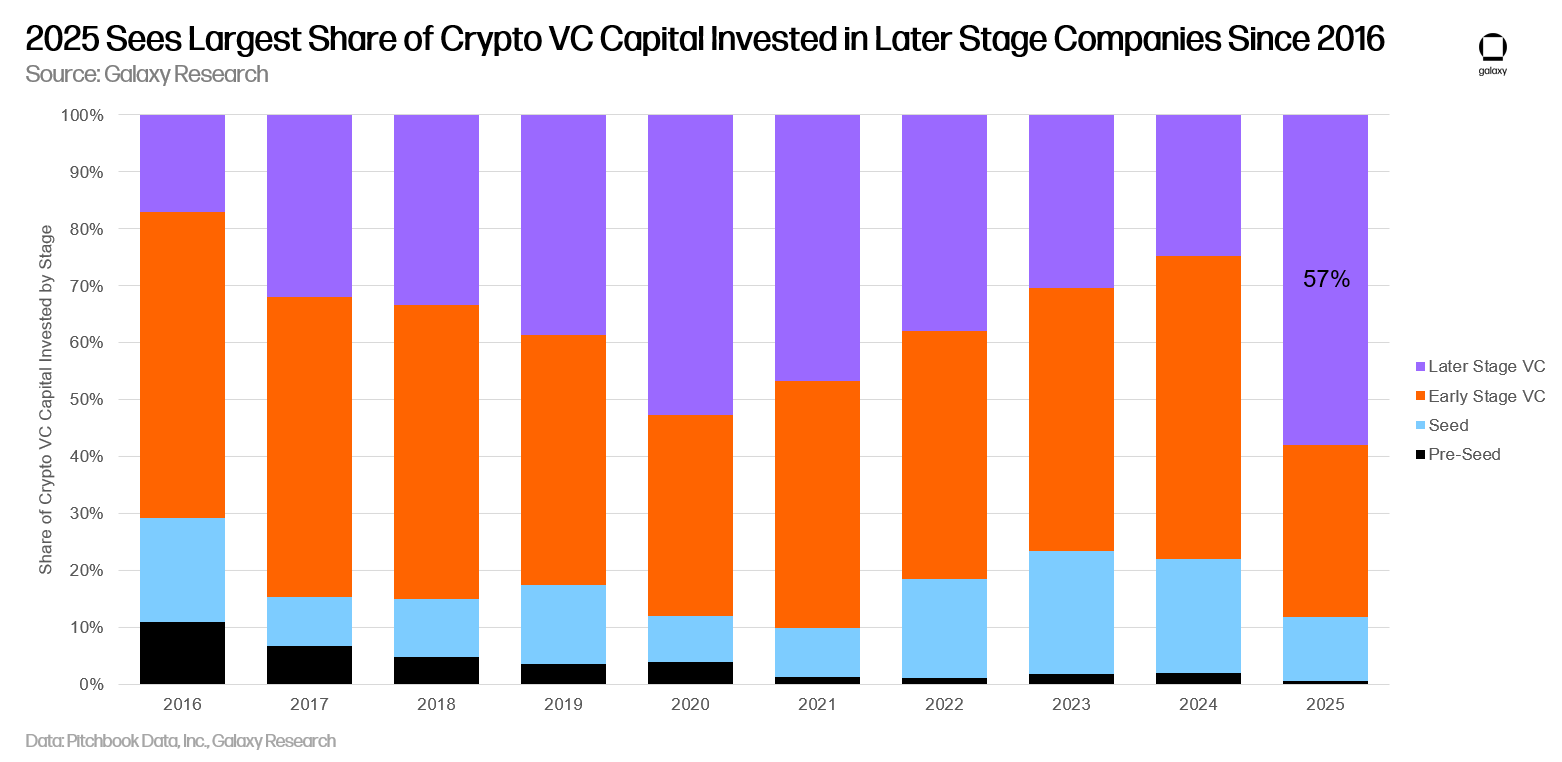
If you just need the short version, here it is. Crypto startups raise money in stages: pre-seed (an idea and a team), seed (an early product), early stage (Series A and B, a product with users), and later stage (a scaled business). Each stage trades equity — and often future tokens — for cash. In Q1 2026, later-stage companies captured about 57% of all capital invested while younger companies took 43%, and the median crypto deal size hit a record above $4.5 million. If you are a founder, target the stage that matches your traction and expect valuations to be negotiated off recent comparable deals, not hopes. If you are a user or employee evaluating a company, look up its last raise: who led it, when it closed, and how large it was. A company that raised a real round from named investors within the last two years is usually funded to operate; one that has not raised since 2022 may be living on reserves. Our guide to reading a funding announcement shows exactly how to run that check.
The four stages of a crypto raise
Venture funding is a ladder, and each rung has its own investors, check sizes, and expectations.
Pre-seed is the first outside money. The company may be two founders and a technical prototype. Checks often come from angel investors, small funds, and accelerators. Galaxy's data shows pre-seed deals made up 19% of completed crypto deals in Q1 2026 — a meaningful share, though down from earlier quarters, which Galaxy reads as a sign of a maturing market.
Seed rounds fund the first real product. By this point there is usually something on mainnet or in an app store, plus early users. Seed remains the busiest part of the crypto market by deal count, and it is where most of the industry's household names started. We cover the mechanics — check sizes, dilution, and what seed investors expect — in our dedicated guide to seed funding for crypto startups.
Early stage (Series A and B) is where institutional venture firms write larger checks against demonstrated traction: revenue, volume, developer adoption, or user growth. Later stage (Series C and beyond, plus growth rounds) funds companies that already work at scale — exchanges, custodians, payment networks — and it is where the largest dollar amounts concentrate.
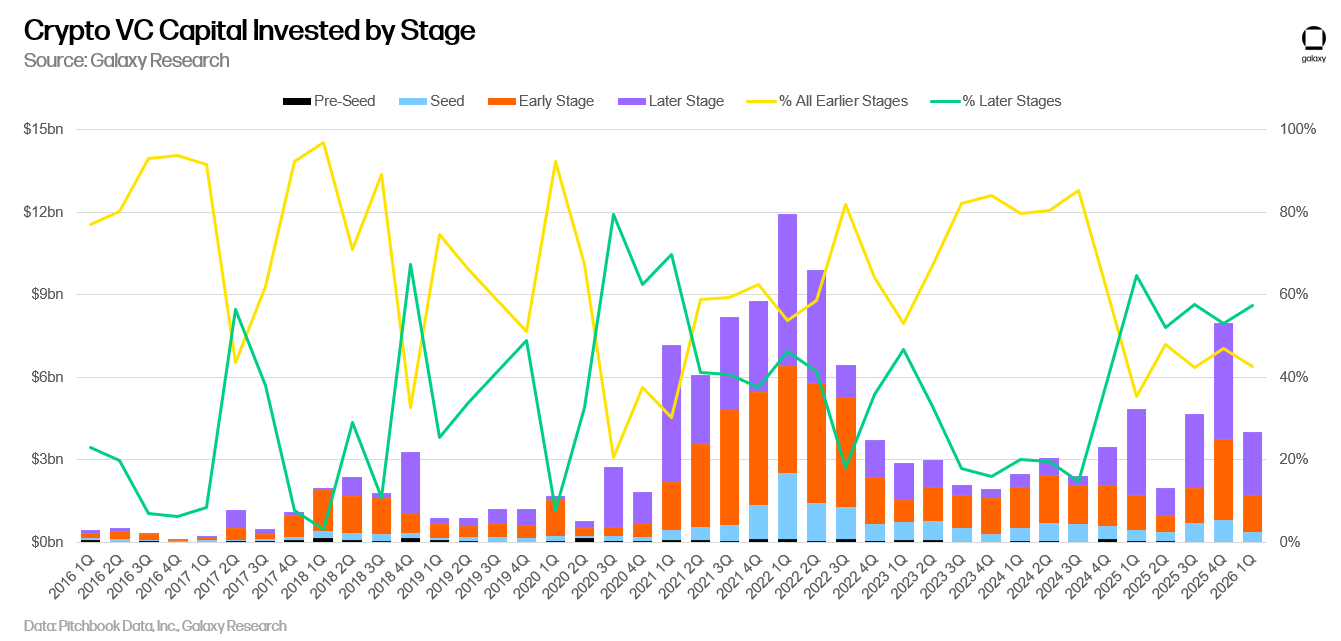
The stage split matters because it tells you where the money actually goes. In Q4 2025, later-stage deals captured 56% of capital invested; in Q1 2026 the later-stage share was about 57%. That does not mean young companies are frozen out — it means a handful of very large late rounds (Revolut's $3 billion raise alone, in Q4 2025) dominate the dollar totals while hundreds of smaller checks fund the next generation underneath.
The table below compiles the four stages side by side, using stage definitions and Q1 2026 shares from Galaxy Research's quarterly report along with the round mechanics that recur across disclosed crypto deals. The pattern to notice: deal counts concentrate early, dollars concentrate late.
| Stage | What exists at this point | Typical investors | Share of Q1 2026 activity |
|---|---|---|---|
| Pre-seed | Team, idea, prototype | Angels, accelerators, micro funds | 19% of deals |
| Seed | First product, early users | Seed funds, crypto-native VCs | Largest share of deal count with early stage |
| Early stage (Series A-B) | Traction: revenue, volume, adoption | Institutional VC firms | Bulk of remaining deal count |
| Later stage (Series C+) | Scaled, revenue-generating business | Growth funds, crossover investors | About 57% of capital invested |
More in Venture & Funding
What a round actually trades
A venture round is a purchase of ownership. Investors wire cash; the company issues them preferred shares at a negotiated valuation. Crypto adds a twist: many startups plan to launch a token, so investors often negotiate token rights alongside equity — through instruments like token warrants or side letters that grant a share of a future token supply. How those instruments work, and how they differ from a simple equity deal, is its own topic; the short version is that a crypto investor frequently ends up with two claims: one on the company and one on the network it launches.
Valuations are set by negotiation, anchored to comparable deals. Galaxy's data shows the median pre-money valuation for VC-backed crypto companies reached record highs in Q4 2025 — exceeding even 2021's peak — before easing modestly in Q1 2026, while the median crypto deal size climbed to a new all-time high above $4.5 million. Crypto valuations also run well above the broader venture market's medians, a premium that reflects both the sector's upside and the token-driven exit paths available to crypto investors.
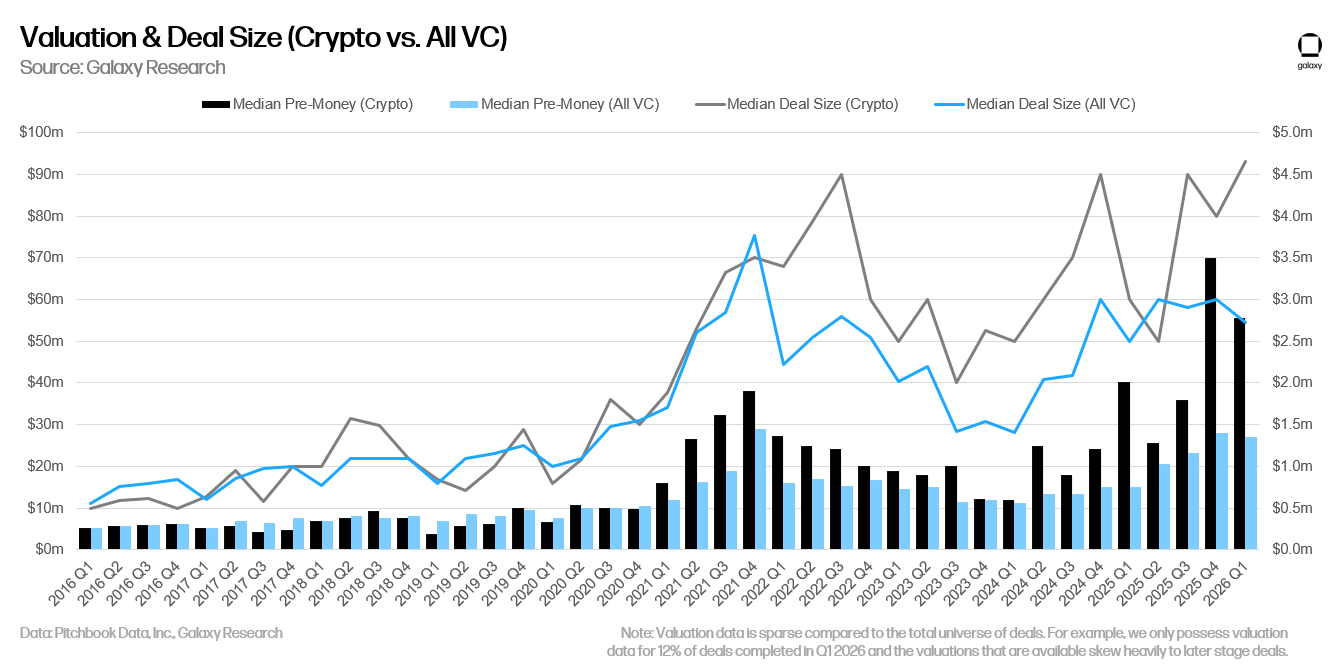
One caveat straight from the source: valuation data is sparse. Galaxy notes it has valuation data for only 12% of deals completed in Q1 2026, and the disclosed valuations skew toward later-stage deals. Treat median valuation charts as a directional signal, not a price list. If you want to understand how investors actually arrive at a number for a specific company, our walkthrough of how crypto startups are valued goes deeper.
Two more dimensions of the data are worth reading before you raise or take a job: category and geography.
By category, money is concentrated. Galaxy's Trading/Exchange/Investing/Lending bucket pulled in roughly $2.6 billion in Q1 2026 — about three-fifths of all capital invested — and also led deal count with 74 deals. Wallet companies ranked second by dollars at roughly $270 million, followed by Infrastructure, Tokenization, AI, Web3/NFT/DAO/Metaverse/Gaming, Payments/Rewards, and Compliance. Deal count tells a more diverse story: Infrastructure logged 56 deals, Web3/NFT/DAO/Metaverse/Gaming 39, Payments/Rewards 33, Tokenization 25, DeFi 23, and Privacy/Security 22. In other words, the biggest checks go to trading businesses, but founders across many categories are still getting funded.
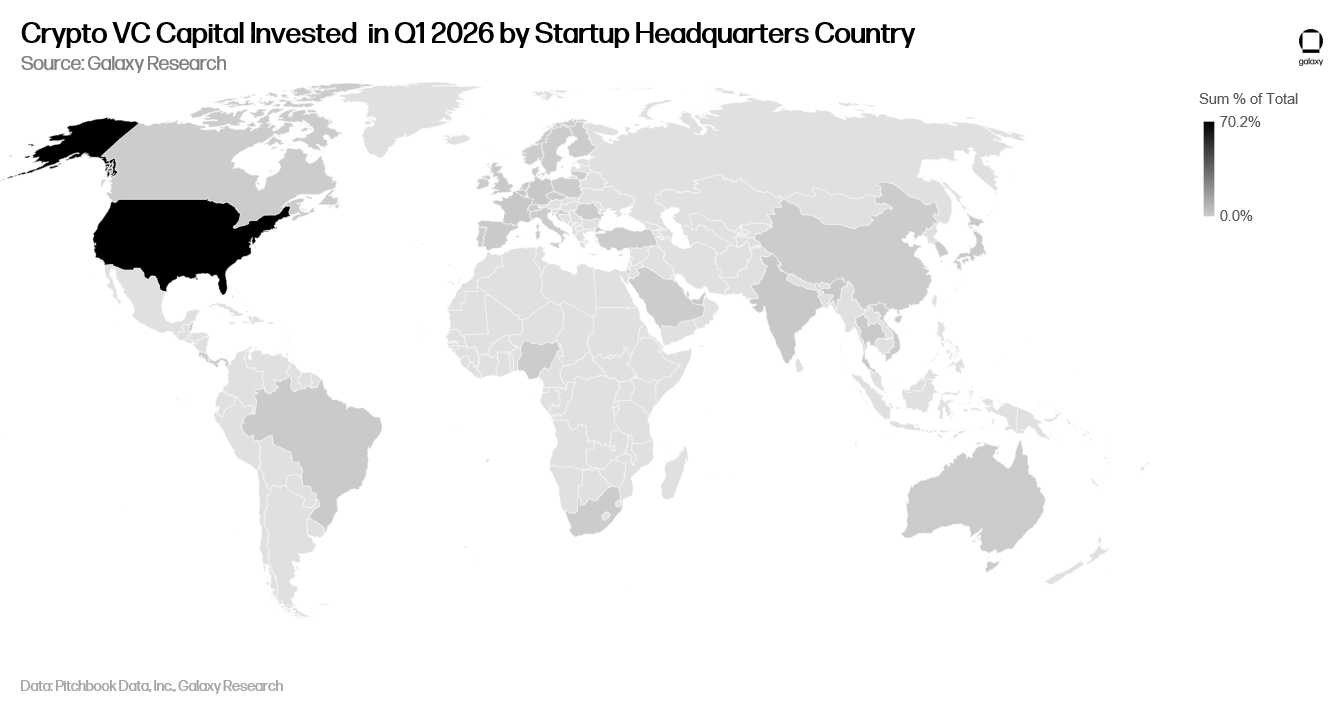
By geography, the United States dominates and its lead is growing. U.S.-headquartered startups captured 70.2% of all crypto venture capital invested in Q1 2026 and 43.5% of completed deals. For founders elsewhere, that is not a wall — most rounds outside the U.S. still happen — but it shapes where the largest funds and the largest rounds cluster.
Who is on the other side of the table
The funds writing these checks have their own funding problem. A venture firm raises money from limited partners — endowments, pensions, family offices, corporations — and deploys it over several years. When limited partners get cautious, new fund formation slows, and that eventually constrains how much money is available for startups.
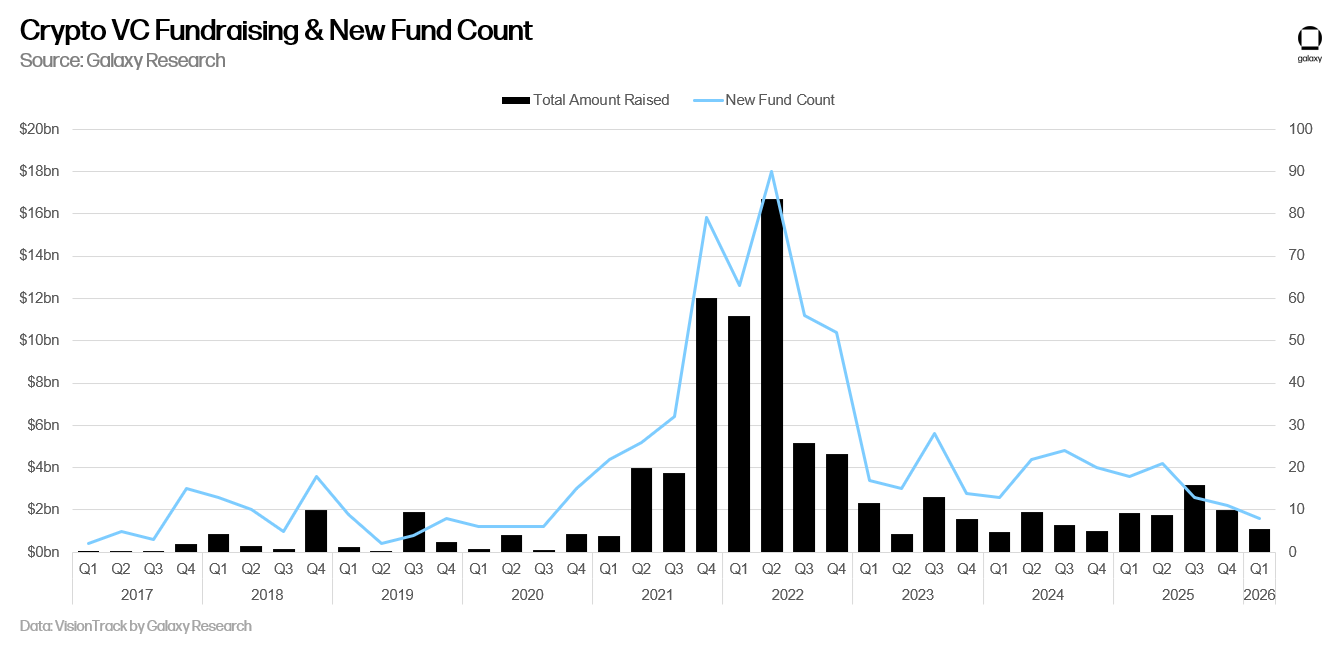
That squeeze is visible right now. Galaxy reports that Q1 2026 saw the fewest new crypto venture funds raised since Q3 2020: roughly $1.1 billion allocated across just eight new funds. Compare that with 2021-2022, when tens of billions flowed into new crypto funds in a single year, and you can see why competition among startups for the remaining capital has stiffened. The structure of these funds — management fees, carried interest, fund lifecycles, and why a fund must eventually return money to its backers — is covered in our explainer on how crypto venture funds work.
For a startup, the practical consequence is that the bar is higher than the headline totals suggest. The $4 billion deployed in Q1 2026 went disproportionately to later-stage companies with proven businesses. Earlier-stage founders are still raising — 43% of the quarter's capital went to younger companies — but they are doing it in a market where fund managers must justify every check to their own cautious backers.
The same data that helps founders plan a raise gets misread constantly. These are the recurring errors we see.
- Raising at the wrong stage. Pitching Series A investors with a pre-seed story — no product, no traction — wastes months. Match your ask to what you can prove today, not to what you plan to build.
- Anchoring to peak valuations. Founders who anchor to Q4 2025's record medians ignore the note under the chart: those medians come from the 12% of deals that disclose, and they skew late-stage. Price off genuinely comparable recent deals at your stage and category.
- Reading headline totals as easy money. A $20 billion year sounds abundant until you see that 11 deals took 85% of Q4 2025's haul. Strip out the mega-rounds and the market available to a typical startup is far smaller.
- Ignoring the fundraising side of the market. When new fund formation hits a five-year low, the money available two years from now shrinks. A founder planning a seed round today should assume the Series A market in 2027 will be selective, and manage runway accordingly.
There is one more misread worth flagging for users rather than founders: a big raise is not a safety guarantee. Venture backing means professional investors believed in the business at some point — it does not mean the product is safe, audited, or profitable. Funding history is one input into trust, alongside security practices and regulation. And when a funded startup stops growing, the most common outcome is not a shutdown but a sale; our guide to crypto mergers and acquisitions explains what happens then.
Who needs to understand this market
Different readers use this data differently. Three situations cover most of them.
"We are a two-founder infrastructure startup preparing our first outside raise." Your market is the 19% of deals happening at pre-seed. Study which funds led recent pre-seed and seed deals in your category — Galaxy's category tables name the active segments — and approach investors who have actually written checks like yours in the last two quarters, not the growth funds behind the headlines.
"We are a small research team deciding whether to join a funded crypto company." Look up the company's last round: stage, size, date, and lead investor. A Series B closed in late 2025 at a healthy size usually means multi-year runway. A seed round from 2022 with silence since is a prompt to ask the company directly about runway during interviews.
"We are a family office evaluating our first allocation to a crypto venture fund." The fundraising chart is your context: eight new funds raised about $1.1 billion in Q1 2026, the slowest quarter since 2020. Scarce supply of new funds cuts both ways — less competition for allocations, but also a signal that institutional peers are cautious. Diligence the manager's track record across at least one full cycle, not just the 2021 vintage.
How the market cycle actually behaves
Crypto venture capital is cyclical, but the cycle is loosening its tie to token prices. In 2017 and again in 2021, venture capital surged almost in lockstep with bitcoin's price. Galaxy's analysis shows that correlation has weakened: bitcoin reached new highs in late 2025 while venture activity stayed uneven, and in Q1 2026 both pulled back together after Q4's spike.
The deal count tells the healthier story. Even in Q1 2026's cooler quarter, 355 deals closed — down 16% from Q4, far less than the 50% drop in dollars. Small rounds kept getting done; what disappeared was the concentration of mega-rounds. Annualizing Q1 implies roughly $16 billion of investment in 2026 — below 2025's total, but comfortably above the pace of the 2023-2024 trough.
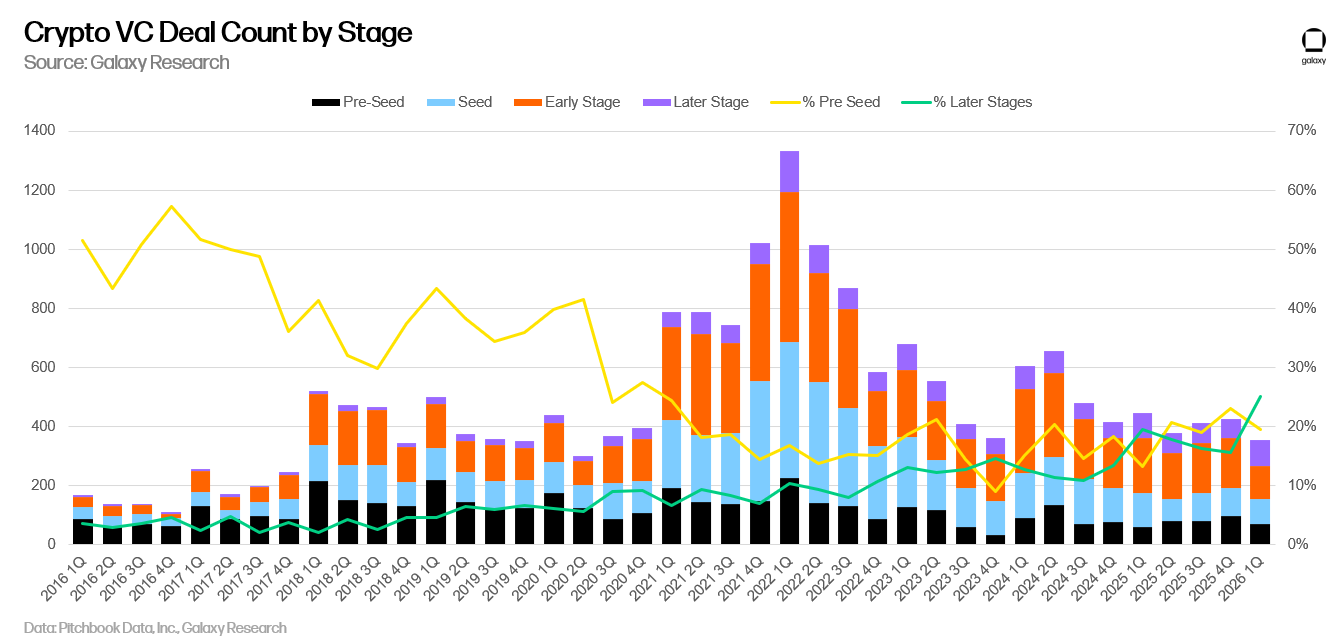
For anyone building, hiring, or investing in this industry, that is the number to watch. Capital invested measures how much the biggest companies raised. Deal count measures how many teams got funded at all — and it has proven the steadier signal through every swing of the cycle.
Frequently asked questions
How much venture capital goes into crypto startups?
Roughly $20 billion across 1,660 deals in 2025, per Galaxy Research — the largest annual total since 2022. Q1 2026 added about $4 billion across 355 deals. Quarterly totals swing widely because a handful of mega-rounds can double a quarter's dollar figure on their own.
What is the difference between pre-seed, seed, and Series A in crypto?
Pre-seed funds a team and a prototype, seed funds a first product with early users, and Series A funds demonstrated traction such as revenue or volume. Later rounds fund scale. The labels describe maturity, not legal categories, and check sizes rise at each step.
Do crypto VCs get tokens or equity?
Often both. The standard instrument is preferred equity, and when a startup plans a token launch, investors typically negotiate token rights alongside it through warrants or side letters. Pure token deals still happen but are less common at institutional funds than they were in 2021.
What share of crypto venture funding goes to US startups?
In Q1 2026, U.S.-headquartered startups captured 70.2% of capital invested and 43.5% of completed deals, per Galaxy Research — a dominant and strengthening share of both dollars and deals.
Is a big funding round a sign a crypto company is safe to use?
No. A raise means professional investors valued the business; it says nothing directly about security, custody practices, or profitability. Treat funding history as one trust signal among several, and weigh security track record and regulatory standing at least as heavily.
Sources
Galaxy Research
Galaxy Research
Architect Partners